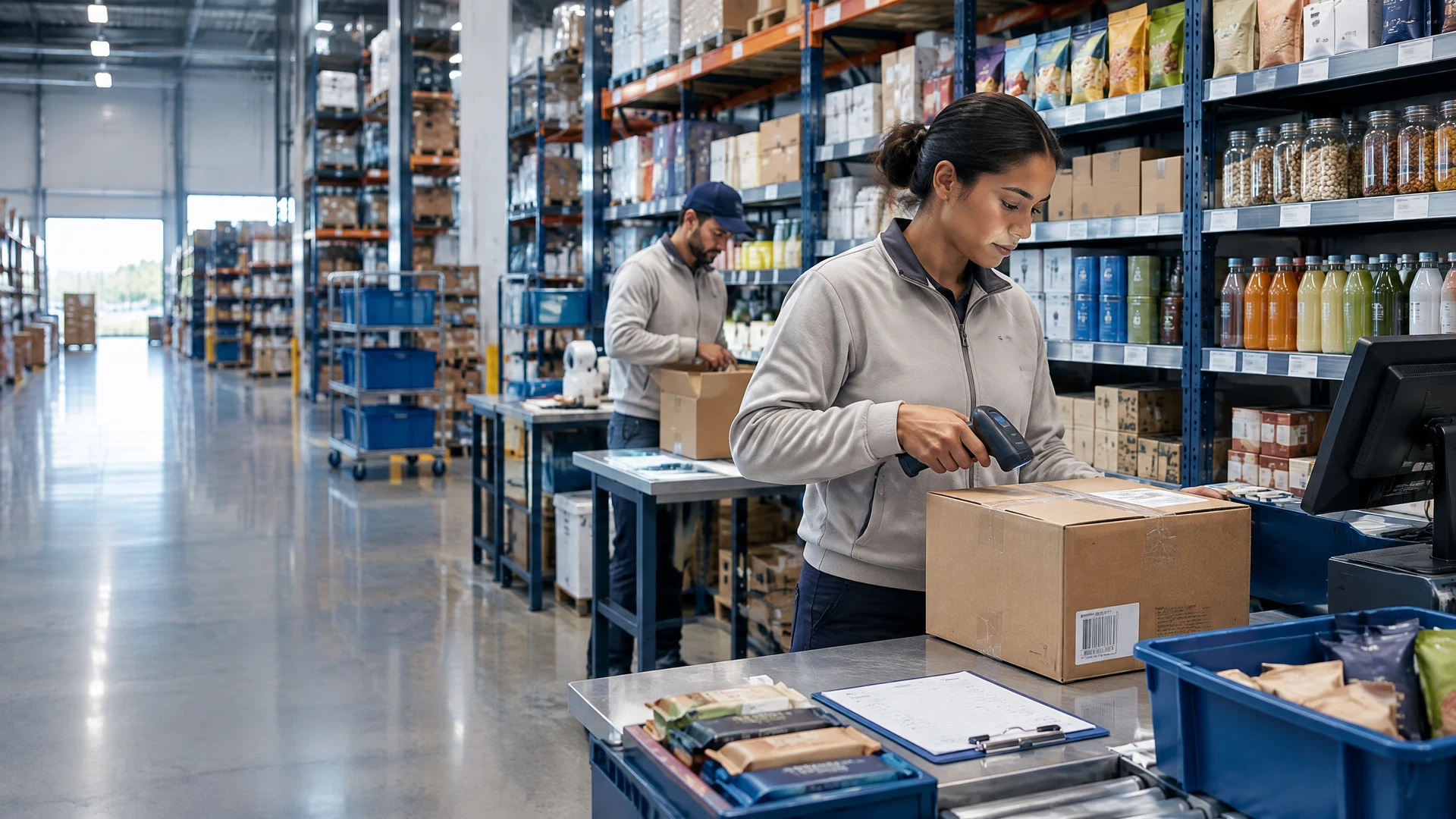
Food and beverage ecommerce orders prepared with lot scanning and clean pack-out controls in a modern fulfillment warehouse
Food & Beverage Fulfillment

Fulfillment That Protects Product Integrity—and Brand Momentum

Coordinate lot-aware inventory, date rotation, documented storage requirements, clean pack-outs, subscriptions, retail replenishment, and campaign demand in one scalable ecommerce operation.

Lot and date visibility

Maintain operational records for lot-coded and date-sensitive inventory from receiving through shipment, according to the program configured with your team.

Product-specific handling

Translate approved storage, sanitation, allergen-separation, packaging, and quality requirements into documented warehouse workflows.

DTC and campaign readiness

Support everyday ecommerce, subscription cycles, bundles, wholesale replenishment, creator programs, and concentrated live-commerce demand.

The operating challenge

Food fulfillment connects customer experience with product status, traceability, and disciplined execution

A food or beverage order may look simple at checkout, yet the physical workflow can depend on lot identity, best-by or expiration dates, storage conditions, package integrity, allergen considerations, bundle components, shipping service, and destination. When one of those attributes is missing or disconnected from the order, the warehouse is forced to guess—or stop the shipment.

Growth adds pressure from new flavors, seasonal assortments, subscriptions, retail cartons, samples, influencer campaigns, and live-selling events. Dropp designs the operating flow around the brand's approved product requirements, inventory statuses, release rules, quality checks, and escalation responsibilities so clean orders keep moving while exceptions remain visible.

Source-backed operating context

Compliance starts with product-specific requirements—not a generic warehouse claim

FDA requirements vary by product, activity, facility, and applicable exemptions. Brands should work with qualified food-safety and legal professionals to determine their obligations. The fulfillment design then converts those approved requirements into receiving, storage, inventory, packing, shipping, records, and recall-support workflows.

Preventive controls and CGMP context

FDA explains that generally covered facilities need a written food safety plan with hazard analysis and risk-based preventive controls. The rule discusses process, allergen, sanitation, monitoring, corrective-action, verification, supply-chain, and recall-plan requirements.

FDA preventive controls

Food traceability records

For foods and entities subject to the Food Traceability Rule, FDA describes records containing Key Data Elements for Critical Tracking Events such as shipping and receiving. Applicability, exemptions, and current timing must be evaluated for the specific business.

FDA traceability rule

Sanitary transportation

FDA's sanitary-transportation framework addresses practices involving shippers, loaders, carriers, and receivers, including suitable equipment, contamination prevention, temperature-related responsibilities where applicable, training, and records.

FDA sanitary transportation

This page describes operational capabilities and planning concepts, not legal, regulatory, food-safety, or product-specific advice. Dropp configures services only after the brand defines the applicable product, storage, handling, documentation, and shipping requirements.

Purpose-built operating controls

A fulfillment system designed around the product—not just the parcel

Every program begins with product classification, operating requirements, channel commitments, forecast, package profile, and inventory data. The resulting workflow can combine standard ecommerce speed with the additional controls required by the approved food or beverage program.

Lot and Date-Aware Receiving

Capture the agreed lot, production, best-by, expiration, quantity, condition, and inbound-reference data at receipt, then separate discrepancies or pending review before inventory becomes available.

Status-Controlled Inventory

Distinguish available, allocated, damaged, quarantined, inspection-pending, expired, recalled, sample, and other approved statuses so non-sellable units do not enter normal allocation.

FEFO and Rotation Rules

Configure first-expired-first-out or other approved rotation rules by SKU and channel, with minimum remaining-life requirements and visible exceptions when inventory cannot meet the order rule.

Documented Storage Requirements

Map approved ambient, temperature, humidity, segregation, sanitation, pest-control, and handling expectations to the selected facility and operating zone; not every Dropp facility supports every requirement.

Allergen and Cross-Contact Planning

Implement program-specific separation, cleaning, identification, workstation, and material-handling instructions defined by the brand's qualified food-safety team where allergen controls are required.

Kitting, Bundles, and Samples

Build variety packs, starter kits, seasonal gift sets, subscription assortments, promotional bundles, and sample programs using controlled bills of material, version rules, and quality checks.

Clean Pack-Out and Parcel Design

Select approved cartons, mailers, dividers, seals, insulation, protection, and inserts based on product integrity, leakage risk, dimensional cost, presentation, and customer promise.

Traceability and Recall Support

Preserve agreed receiving, inventory, transformation or kitting, shipping, and destination records; isolate affected units; identify impacted orders; and support the brand's documented recall or withdrawal process.

Flexible by product profile

Shelf-stable food and beverage programs are not all the same

The operating design should follow actual product characteristics and approved requirements. Dropp evaluates facility fit and service scope before onboarding; products requiring capabilities outside the selected operation are not accepted into a standard workflow.

Packaged snacks and pantry goods

Coordinate lot-coded cases and units, date rotation, case integrity, variety packs, subscriptions, and parcel-ready protection for shelf-stable products.

Bottled and canned beverages

Plan weight, breakage or leakage risk, case handling, protective packaging, dimensional economics, and shipping-service eligibility for non-alcoholic beverages.

Giftable and premium assortments

Control presentation, inserts, seasonal versions, samples, protective materials, and quality checks for customer-ready bundles and corporate gifting.

Subscriptions and creator drops

Reserve components, manage order locks, execute recurring or event-driven kitting waves, and protect inventory shared across Shopify, Whatnot, TikTok Shop, and other channels.

How it works

A controlled path from product approval to customer delivery

The workflow is configured before launch, tested with representative products and orders, then governed through shared data, exception rules, performance reporting, and periodic review.

01

Define product and compliance requirements

Document SKU, lot and date fields, storage range, package integrity, allergens, handling, channel, shipping, records, recall responsibilities, and facility qualifications approved by the brand.

02

Validate facility and integration fit

Confirm that the selected Dropp operation, systems, storage areas, equipment, labor model, integrations, and carrier options can support the approved requirement before inventory is routed.

03

Receive and control inventory status

Compare inbound appointments and expected data, inspect agreed attributes, record lots and dates, identify discrepancies, and prevent held inventory from becoming sellable.

04

Allocate and rotate correctly

Apply channel reservations, minimum-life rules, FEFO or approved rotation, bundle-component availability, and exception logic before orders enter active warehouse work.

05

Pick, verify, and pack

Use identification, scans, counts, lot or date confirmation where configured, package integrity checks, approved materials, expected weight, seals, inserts, and service rules.

06

Handoff, report, and retain records

Complete carrier handoff, return tracking to channels, preserve agreed transaction records, reconcile exceptions, and review inventory, quality, cost, and customer outcomes.

Inventory discipline

Visibility by lot, date, status, and destination

The inventory record should explain what a unit is, where it is, whether it is eligible, which lot and date attributes apply, and which demand has already reserved it. That clarity protects availability while supporting targeted investigation and response.

ControlWarehouse executionBusiness outcome
Inbound identityMatch purchase order or ASN, SKU, quantity, lot, date, condition, and approved documentsStops unidentified or discrepant stock from entering normal availability
Inventory statusSeparate available, allocated, held, damaged, recalled, expired, and inspection-pending quantitiesPrevents ineligible units from shipping
RotationApply FEFO, FIFO, minimum remaining life, or a brand-approved rule by product and channelReduces avoidable expiry while protecting customer and channel requirements
Location and segregationAssign storage zones according to approved environmental, allergen, packaging, and handling requirementsMakes facility rules visible in daily work
Order traceabilityAssociate shipped quantities with the agreed lot, order, destination, and transaction timestampsSupports targeted investigation, withdrawal, or recall execution
Cycle countingPrioritize high-velocity, date-sensitive, high-value, and discrepancy-prone inventoryImproves allocation confidence and detects root causes earlier

Recall and exception readiness

Plan the response before an urgent event

A 3PL does not decide whether a brand must initiate a market withdrawal or recall. The brand and its qualified advisors own that decision. The warehouse must know how to stop allocation, isolate affected inventory, identify impacted orders and destinations, preserve evidence, control disposition, and communicate status through the approved command structure.

The same discipline helps with smaller events: damaged cases, temperature or seal concerns, incorrect labels, supplier holds, date discrepancies, and customer complaints. Reason-coded exceptions should have an owner, severity, timestamp, affected inventory, decision deadline, and documented resolution.

01

Identify

Receive the brand's product, lot, date, supplier, channel, destination, or order scope using an authenticated escalation path.

02

Block

Stop allocation and work in progress, place affected inventory into the approved status, and protect unrelated inventory from unnecessary disruption.

03

Trace

Report on-hand units, movements, kits or transformations, orders, shipments, destinations, and unresolved exceptions using available records.

04

Execute and reconcile

Follow approved instructions for communication support, return, hold, destruction, release, or other disposition, then reconcile quantities and evidence.

Built for DTC growth, subscriptions, and live-commerce demand

Food and beverage brands increasingly combine everyday ecommerce with recurring programs, seasonal launches, creator partnerships, marketplaces, wholesale, and live selling. Dropp connects these demand profiles to shared inventory while preserving explicit reservations, product rules, approved pack-outs, and campaign capacity plans.

Channel reservations

Protect subscription, wholesale, DTC, and live-event inventory with visible allocation and safety-stock rules.

Campaign capacity

Prepare labor, stations, materials, order-release strategy, and carrier handoff for launches and viral demand.

Controlled personalization

Support samples, gift notes, inserts, box versions, bundles, and creator materials with effective dates and approved logic.

Shared performance view

Review backlog, lot and date exceptions, accuracy, damage, shipping, cost, and customer feedback by channel and event.

Operating scorecard

Measure product integrity and fulfillment performance together

Targets are configured for the actual product and solution. The scorecard should separate warehouse performance, inventory risk, integration quality, carrier handoff, and brand-controlled holds rather than hiding every outcome inside one average.

Lot and date capture completeness

Required attributes recorded for the eligible inbound and outbound population.

Inventory accuracy by status

System quantity compared with verified physical quantity for available, held, damaged, and other controlled states.

Rotation compliance

Orders fulfilled according to the approved FEFO, FIFO, remaining-life, or channel rule.

Order and component accuracy

Correct product, quantity, lot or date where required, bundle components, packaging, inserts, and destination.

Damage and leakage rate

Product and packaging incidents segmented by SKU, pack-out, carrier, and root cause.

On-time carrier handoff

Eligible orders physically transferred by the agreed cutoff, with exceptions and evidence separated.

Implementation

A phased onboarding built around representative risk

The program should not launch with only a simple sample order. Testing should include representative lots, dates, bundles, packaging, channels, destinations, holds, damaged units, and urgent exceptions.

01

Discovery and qualification

Review products, food-safety requirements, facility fit, demand, channels, integrations, packaging, service expectations, and excluded activities.

02

Data and process design

Map item attributes, lot and date capture, statuses, rotation, locations, bills of material, quality checks, shipping, records, and escalation ownership.

03

Pilot receipt and order validation

Receive representative inventory, reconcile records, test allocations and exceptions, execute sample orders, and verify customer-facing updates.

04

Controlled cutover and stabilization

Move volume in planned waves, monitor every handoff, compare performance with the baseline, and close corrective actions before adding complexity.

Build a connected food and beverage growth operation

Combine product-aware inventory controls with ecommerce execution, custom kitting, subscription planning, and the platform connections your customers use.

Food and beverage fulfillment FAQs

What kinds of food and beverage products can Dropp fulfill?

Dropp evaluates each program individually. Potential fits include approved shelf-stable packaged foods, pantry goods, snacks, non-alcoholic beverages, gift assortments, samples, and subscription products. Acceptance depends on product characteristics, facility capability, storage and handling requirements, documentation, shipping constraints, and service scope. Not every Dropp facility supports every product or requirement.

Does Dropp provide refrigerated or frozen fulfillment?

Capabilities must be confirmed for the specific facility and program. Do not assume cold-chain service from this page. The brand must provide the required temperature range, monitoring, packaging, transportation, and regulatory requirements so Dropp can determine whether an appropriate solution is available.

Can Dropp track lots and expiration or best-by dates?

Lot and date attributes can be incorporated into receiving, inventory, allocation, picking, reporting, and exception workflows when configured for the program. The exact fields, capture method, rotation rule, record retention, and channel requirements must be defined during solution design.

Can you use FEFO inventory rotation?

Yes, a first-expired-first-out rule can be configured where appropriate, along with minimum remaining-life and channel-specific requirements. Some products or business models may use a different approved rotation rule. Exceptions should remain visible rather than silently bypassing the rule.

How does Dropp support food recalls?

Dropp can support the brand's documented process by blocking affected inventory, reporting available stock and movements, identifying impacted orders and destinations from available records, controlling disposition, and preserving evidence. The brand and its qualified advisors remain responsible for regulatory decisions, required notifications, and recall governance.

Can Dropp assemble variety packs and subscription boxes?

Yes. Programs can support variety packs, gift sets, samples, promotional bundles, and recurring subscription assortments through approved bills of material, component inventory, lot and date rules, pack-out instructions, and quality checks.

Can food inventory support Shopify, Whatnot, and TikTok Shop orders?

Yes, subject to product and channel eligibility. The operating design can coordinate Shopify ecommerce with approved marketplace and live-commerce orders while reserving inventory, mapping listings to physical SKUs, applying channel-specific pack-outs, and monitoring concentrated demand.

What information is needed to evaluate a food fulfillment program?

Provide the product catalog, ingredients or allergen context relevant to handling, packaging, lot and date data, required storage conditions, case and unit dimensions, expected shelf life, forecast, channel mix, order profiles, bundle rules, shipping destinations, quality standards, records, insurance, and regulatory requirements. Dropp will use that information to assess facility and service fit.

Build a food fulfillment program designed around your product

Tell us about your catalog, lots and dates, storage and handling requirements, packaging, channels, subscription or live-commerce plans, forecast, and customer promise. We will map facility fit and operating requirements before launch.

Request a Custom Assessment