

A Lightweight Product Can Still Create a Heavy Shipping Bill
The product on the scale is only part of the shipping calculation. A large box around a light item occupies space in vehicles and sorting facilities. Dimensional weight converts that occupied space into a weight basis used for pricing. FedEx explains that a shipment can be charged on dimensional weight or actual weight, whichever is greater. [1] The precise application still depends on the service and the applicable terms.
For an ecommerce brand, this creates an operating question rather than a reason to squeeze every product into the smallest available container. The goal is a repeatable protected pack-out that uses space sensibly and can be measured, priced, and audited. A cheaper theoretical label is not useful if the product breaks, the packing instruction is impractical, or the invoice uses different dimensions from the estimate.
This guide provides an illustrative calculation and a proposed improvement method. It is not a carrier quote, a Dropp rate card, or a guarantee of savings. Keep the fulfillment pricing resource open alongside your own service agreement and representative shipment records.
| Question | Why it matters |
|---|---|
| What are the finished outside dimensions? | Inner carton size is not necessarily the shipped size |
| Which service and rate agreement apply? | Divisors, rounding, minimums, and charges can differ |
| What is the actual packed weight? | Protection and materials add weight |
| Which weight controls billing? | The DIM result is an input, not the whole invoice |
| Does the revised pack-out protect the product? | Lower volume alone does not establish a better result |
1. Separate Product, Retail Pack, and Shipping Parcel
The dimensions on a supplier's product sheet may describe the item itself, its retail box, or a master carton. None automatically describes the parcel sent to the customer. A bottle packed with cushioning inside an outer carton has several layers. A two-item basket has another configuration. The shipping record should identify the actual finished parcel.
Capture internal SKU, basket or kit definition, outer-container version, exterior length, width, height, packed weight, protection materials, and the date measured. Record the unit system explicitly. Do not mix centimeters with an inch-based divisor or treat ounces as pounds without conversion. Match the record to a physical production-ready sample.
UPS describes measurements based on the package's longest extents, including treating irregular shapes as if enclosed in a rectangular box. [2] Bulges, protrusions, and soft packaging can therefore matter. Measure what will enter the carrier network rather than relying on the flat empty package or the supplier's nominal carton name.
2. Verify the Rule Before Running the Formula
The basic relationship is dimensional weight = measured length × width × height ÷ applicable divisor. UPS's public guidance distinguishes divisors by rate type and directs shippers to the rate and service guide for billable weight. [2] FedEx's public explainer uses 139 in its example. [1] Those pages do not make every agreement, carrier, or shipment identical.
Check the current service guide, rate agreement, measurement units, dimensional rounding, result rounding, minimum billable weight, and any thresholds relevant to the parcel. Public educational pages can use simplified wording or lag detailed service updates. If a page and your controlling guide differ, obtain confirmation rather than applying a remembered rule to every label.
This article deliberately uses whole-inch exterior dimensions so the example does not depend on resolving fractional-inch rounding. It assumes a divisor of 139 and rounds the calculated dimensional result upward to a whole pound. These are stated example assumptions, not a statement that the same rule governs all ecommerce shipping.
3. Work Through a Transparent Example
Consider an illustrative parcel with an actual packed weight of 3 lb. Its outer dimensions are 16 × 12 × 10 inches. Under the stated 139 divisor, the volume is 1,920 cubic inches and the dimensional result is 13.812950 lb to six decimal places, or 14 lb after the example's upward whole-pound rounding. The dimensional result exceeds the actual packed weight.
Suppose a tested alternative can safely ship the same contents at 12 × 10 × 6 inches, still weighing 3 lb. Its volume is 720 cubic inches. Dividing by 139 gives 5.179856 lb, or 6 lb under the same rounding assumption. The revised example still has a dimensional result greater than actual weight.
| Example input or result | Original parcel | Tested alternative |
|---|---|---|
| Outside dimensions | 16 × 12 × 10 in | 12 × 10 × 6 in |
| Actual packed weight | 3 lb | 3 lb |
| Assumed divisor | 139 | 139 |
| Volume | 1,920 cu in | 720 cu in |
| Dimensional result (six decimal places) | 13.812950 lb | 5.179856 lb |
| Rounded dimensional result | 14 lb | 6 lb |
| Example weight basis before other rules | 14 lb | 6 lb |
The calculation demonstrates a change in a weight basis, not an eight-pound product weight reduction or a dollar saving. Rate steps, zones, minimums, packaging cost, labor, and surcharges can change the invoice result. Validate the actual charge with the chosen service and agreement before reporting a commercial benefit.
4. Measure the Full Packed Unit at the Packing Bench
A reliable measurement process should specify the device, unit, package state, and person responsible. Measure after protection and sealing, not while the carton is still open. Recheck measurements when materials, product mix, or suppliers change. A revised tissue wrap may not matter; a thicker protective cradle or a taller bundle can change the finished parcel materially.
Keep scale and dimension records together. An accurate weight paired with the wrong carton dimensions is still a bad shipping input. Use a stable packaging code so the warehouse can connect the instruction, physical materials, label system, and invoice investigation. Avoid free-text entries that describe the same pack-out several different ways.
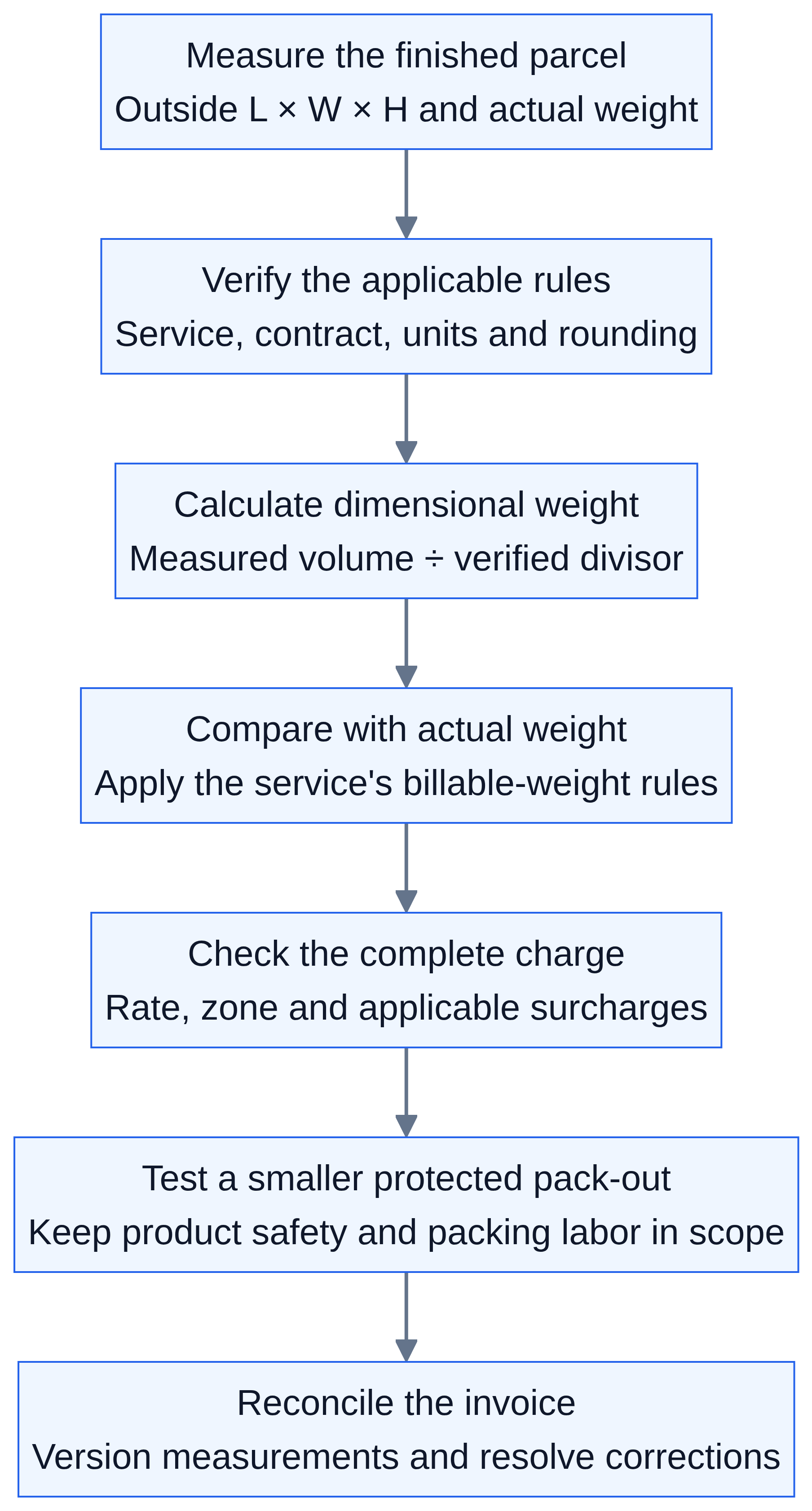
Original editorial workflow. Carrier-specific rules are verified before calculating the charge basis; protection testing comes before broad adoption.
For exceptions, require a new measurement rather than forcing the basket into the nearest standard record. If a parcel needs a larger outer carton, update the record and rate estimate before shipping where the workflow permits. Recording the true parcel is preferable to choosing an inaccurate dimension merely to preserve a quoted label price.
5. Right-Size Without Under-Protecting
FedEx recommends matching packaging to item size and fragility and notes that underpacking can risk damage. [1] Use that principle as a design constraint. A product can need cushioning clearance, dividers, edge protection, or leak containment. Eliminate unnecessary space only after understanding which parts of the pack-out perform those functions.
Start with one high-volume basket and one fragile or irregular basket. Develop alternatives with clear packing instructions, measure them, and run appropriate protection tests. Document the product's condition, material consumption, packing time, and any failure. A test should represent the shipped arrangement rather than a carefully assembled sample that ordinary operators cannot reproduce.
The budget-conscious unboxing guide explains how restrained presentation and a repeatable pack-out can support brand experience. Redesign a presentation sleeve or insert if it forces an unnecessary outer size, but do not remove protection because it appears visually excessive without checking what it does.
6. Evaluate Cartons as a Portfolio, Not Individually
One universal carton simplifies purchasing but may create avoidable volume for many baskets. An enormous carton catalog can produce another problem: confusing choices, more storage, more replenishment work, and inconsistent operator selection. Choose a practical portfolio that covers representative baskets and can be replenished reliably.
Map order history to candidate pack-outs. Consider single-item orders, common pairs, subscriptions, promotional kits, and live-show combinations. Identify which products can use a mailer and which require a rigid protective container; do not assume every lightweight product is suitable for a flexible package. Product protection and service compatibility remain prerequisites.
Version the approved choice with product and material availability. If the preferred carton runs out, operators need an authorized alternative and a measurement rule. Improvisation under a dispatch deadline can erase both the pricing estimate and the brand's consistency. The kitting and assembly guide connects finished kits to the stock and material controls behind them.
7. Manage Multi-Item and Live-Commerce Baskets Carefully
A Whatnot buyer may purchase several items during a show; a TikTok promotion may feature a bundle that differs from ordinary DTC orders. Combining items can alter size, weight, protection, service eligibility, and the relationship between orders and tracking. Do not assume that sharing a buyer automatically authorizes a combined parcel.
Verify current channel combining and label rules first, then approve the physical configuration. Keep all order and line identities associated with the parcel. If a bundle becomes two parcels, establish the correct tracking mapping and stock events. A dimensional estimate for a one-unit item cannot price a multi-line basket accurately.
Use the Whatnot guide and TikTok Shop guide to distinguish those channels. The Shopify guide addresses platform-to-warehouse identity. A surge plan should reserve the approved materials as well as merchandise; the lowest theoretical shipping cost is irrelevant if the required cartons are unavailable during the campaign.
8. Compare the Complete Cost and Quality Outcome
Estimate shipping with the relevant origin, destination, service, and measured parcel. Include the materials and handling needed for each alternative. Check which additional charges or size rules apply under the current agreement. Do not claim that a lower dimensional result automatically removes a surcharge that has a separate trigger.
Use a consistent cohort of orders and destinations for the comparison. Changing from distant oversized baskets to nearby single-item orders can make an unmodified pack-out appear cheaper. Retain the same demand assumptions and disclose the protection standard. Review whether the revised instruction creates slower handling or more exceptions.
| Evaluation dimension | Evidence to retain |
|---|---|
| Shipping estimate | Dated quote, service, destination and measured inputs |
| Materials | Approved version, quantity consumed and supplier cost |
| Packing work | Representative observed handling, not a sales estimate |
| Product protection | Test method, sample and result |
| Actual invoice | Billed measurements, charge basis and applicable adjustments |
| Customer quality | Damage reports and pack-out identity for investigation |
This is an operating comparison, not a commitment that Dropp can lower every shipping bill. The most useful result may be a clearer measurement process, fewer unexplained corrections, or a more reliable approved pack-out rather than a dramatic savings claim.
9. Reconcile Estimates with Carrier Invoices
A label estimate and a final billed parcel can differ. Review the billed dimensions and weight against the saved pack-out record, label data, and the physical configuration. UPS explicitly recommends checking measurements and links guidance on avoiding measurement-correction charges. [2] A correction should be investigated, not automatically labeled a carrier error.
Separate causes: operator used another carton, a soft parcel bulged, source data was stale, units were mixed, the basket changed, or an applicable service rule was not represented in the estimate. Preserve evidence before opening an inquiry through the appropriate account channel. Do not promise a credit before the carrier confirms one.
Track recurring patterns by product and packaging version. If several discrepancies involve the same bundle, examine that instruction instead of arguing every invoice separately. If the label tool rounds differently from the controlling agreement, correct the configuration and retest. Measurement governance is a repeatable responsibility, not an annual spreadsheet cleanup.
10. Build an Improvement Cycle with Clear Acceptance Gates
Select a representative basket, establish a measured baseline, confirm the applicable billing rules, test a protected alternative, price the same destinations, and inspect actual results. Set acceptance criteria before the pilot so an attractive shipping estimate does not excuse a failed protection test. Assign owners for packaging approval, system updates, material purchasing, and warehouse training.
Keep pilot and broad-release instructions separate. Record which orders used the alternative so claims and discrepancies can be linked to the correct version. If the alternative fails, stop that pack-out and preserve evidence rather than retroactively calling the sample unrepresentative. A useful improvement process can reject a smaller box when it is not operationally suitable.
After approval, update the product master, carton list, labels, training references, and quote assumptions together. The SKU management guide and ecommerce fulfillment resource help connect those records. A packaging improvement becomes real only when the everyday operation uses the approved version accurately.
Frequently Asked Questions
Is 139 the divisor for every shipment?
No. It is an explicit assumption in this article's example. UPS's public guide distinguishes rate types, and the current service guide and agreement govern actual rules. Verify units, divisor, rounding, and minimums for the service you use. [1] [2]
Can I use the empty carton's printed size?
Use the finished parcel's actual outside dimensions and packed weight. Nominal or internal dimensions may not describe what enters the carrier network. Measure bulges and protrusions where relevant under the applicable method. [2]
Does reducing dimensional weight guarantee savings?
No. It changes one calculation input. The complete rate, minimums, zone, additional charges, materials, labor, and damage outcomes determine whether the change is worthwhile. The example intentionally includes no dollar claim.
Should I remove cushioning to fit a smaller carton?
Only after an appropriate redesign and protection test. FedEx's guidance balances right-sizing with protection. A pack-out that reduces volume but causes product damage is not a successful optimization. [1]
Prepare a Measured Fulfillment Brief
For a packaging and fulfillment scoping discussion, bring representative baskets, finished dimensions, packed weights, current service rules, label estimates, invoices, and protection requirements. Connect the work to live-commerce fulfillment, the last-mile delivery guide, FAQ, and glossary. Define the evidence before promising the result.
References
Source review: October 12, 2026. Worked figures are illustrative assumptions, not a rate quote or customer outcome. Current service guides and agreements control.