

The Customer Experiences One Order, Not Three Separate Companies
A customer buying from a DTC storefront or a live show expects the right item to arrive when promised. They do not divide the experience into brand operations, warehouse handling, carrier transport, and doorstep delivery. Those divisions are useful internally, but they become a problem when each party assumes that the next one owns an unresolved shipment. A parcel can leave the packing bench without a clear acceptance event, sit at a delivery location without customer instructions, or show a revised date that nobody explains.
This article treats last-mile delivery as the final local delivery stage and connects it to the upstream decisions that make that stage work. Carrier handoff is not itself the last mile. It is an earlier control point that establishes whether the physical shipment and the digital promise agree. The proposed controls below are operational guidance, not guaranteed Dropp results or a promise that every carrier delay can be prevented.
UPS makes the distinction concrete: Label Created records shipment details, Shipped/On the Way reflects possession in its network, and Out for Delivery means the local facility has dispatched the shipment to a driver. An Exception can change the scheduled delivery date. [1] Treat these as different events, not interchangeable labels for an order being finished.
| Stage | Question the brand needs to answer |
|---|---|
| Warehouse processing | Is the correct parcel actually ready? |
| Carrier acceptance | What evidence confirms the handoff? |
| Network transport | Is the delivery estimate still supported? |
| Local delivery | Is there a delivery attempt, pickup requirement, or exception? |
| Resolution | Does the order have a confirmed outcome and an accountable owner? |
1. Define the Promise Before Selecting the Shipping Service
Start with what the shopper sees. A delivery window is an end-to-end promise; a carrier transit description usually covers only part of that journey. Payment review, inventory release, packing, pickup availability, weekends, and the destination can all affect when the final delivery stage begins. Do not turn a carrier service name into an unconditional storefront countdown.
Write a promise matrix by product group, origin, destination, and order type. Include the latest order-release cutoff the operation can support, the available pickup schedule, and the rule for estimating delivery. Identify products needing special packaging, signature decisions, or additional checking. If a promise depends on an unconfirmed warehouse process, narrow the promise rather than asking customer service to explain the difference afterward.
The two-day shipping guide separates transit from total click-to-doorstep time. Use the ecommerce fulfillment resource to align receiving, availability, order release, and carrier collection. Improving the final mile begins with a realistic upstream schedule, not a claim that every parcel will arrive faster.
2. Establish a Carrier-Acceptance Control
A shipping label contains instructions and an identifier. It does not, by itself, establish that the carrier possesses the parcel. UPS's official tracking descriptions distinguish the initial electronic information from network possession. [1] A warehouse may have a perfectly good reason for preparing labels before collection, but the brand still needs to know which labeled parcels remain physically on site.
Build a reconciliation between ready parcels, the pickup or manifest record, and the carrier evidence recognized for the relevant service and channel. Record the order, tracking number, origin, agreed pickup, actual handoff record, and first qualifying event. Investigate gaps in a named queue. Do not backdate events or manufacture a scan to make a deadline look satisfied.
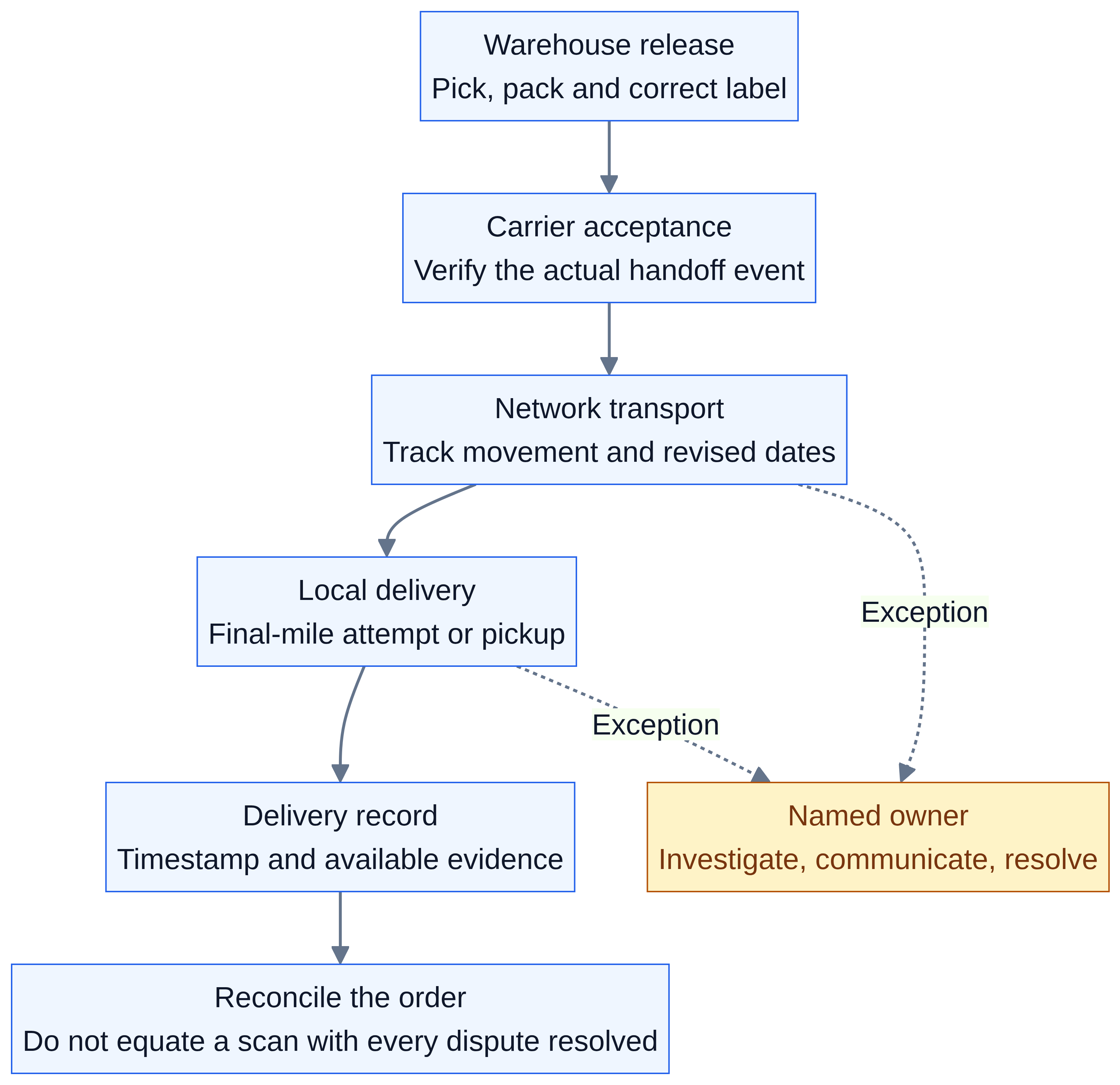
Original operating diagram. The exception path is a proposed control, not a carrier-service guarantee or a report of Dropp customer performance.
Define how the team distinguishes a missing update from a confirmed missed pickup. Ask the carrier or platform what evidence is accepted; do not assume that every manifest or internal scan is equivalent. The objective is traceability and honest escalation, not simply reducing the number of red lines on a dashboard.
3. Make Tracking Useful to Customer Service
A stream of raw carrier messages is not a customer-service plan. Create a shared order view that captures the last verified event, current estimate, exception reason if available, next investigation step, and owner. Preserve the original message so a simplified customer-facing summary does not erase the evidence needed for an inquiry.
UPS explains that long-distance shipments may not be scanned again until the destination hub. [1] Therefore, an unchanged tracking page is not automatically proof that a parcel is lost. Conversely, a reassuring generic status should not hide a missed promise. Use thresholds suited to the actual lane and service, then verify with the carrier before drawing a conclusion.
Differentiate a delivered parcel, a parcel at a pickup location, and a failed attempt. The customer may need to take action in the latter two cases. Avoid closing every order merely because the tracking integration has stopped emitting movement updates. A terminal-looking system value is less useful than a clear, accurate account of what happened and what happens next.
4. Give Exceptions an Owner Before They Occur
An exception should create work for a named role. Address problems, delayed movement, damaged packaging, a missed signature, and a reported non-receipt need different evidence and decisions. Build a small triage matrix instead of sending every case to a general inbox with no service expectation.
| Situation | Initial evidence | Proposed accountable role |
|---|---|---|
| Label exists; handoff unclear | Packing record, pickup record, carrier events | Warehouse coordinator |
| Carrier exception changes estimate | Original event, service, destination, revised date | Logistics lead |
| Attempt unsuccessful | Notice, signature requirement, available actions | Customer-service lead |
| Delivered but not received | Available delivery record and customer's report | Customer-service lead with carrier liaison |
| Wrong product or missing line | Pick/pack evidence and order mapping | Fulfillment quality lead |
These roles are a proposed operating model, not a description of every Dropp account. Confirm the scope in writing. A warehouse can investigate its handoff and pack-out without controlling a driver's route. The brand should remain responsible for deciding what it communicates and for approving customer resolutions within applicable channel policies.
5. Design for Delivery Attempts and Pickup Requirements
Some deliveries require more than leaving a parcel at a doorway. A signature, inaccessible building, or redirected pickup can introduce another action. UPS explains that a delivery notice identifies relevant details and possible next steps, and that available release or pickup options depend on shipment requirements. Its attempt policy is discretionary rather than a universal promise. [2]
Decide signature and destination-service rules before selling. A costly signature requirement that the buyer cannot satisfy can create friction; omitting an appropriate requirement can create another risk. Use product value, channel instructions, available carrier options, and the brand's approved policy to make that decision. Do not silently add a condition that contradicts checkout expectations.
When a notice appears, send the customer the verified action through the permitted communication channel. Explain where to find current instructions rather than inventing a pickup deadline from a previous shipment. Keep sensitive address and identity information out of unrestricted shared documents. A usable instruction should be specific without exposing unnecessary personal data.
6. Treat Packaging as Part of Delivery Reliability
A fast shipment is not a successful shipment if the product arrives damaged. Use an approved pack-out that fits the product, protects vulnerable components, and preserves readable labels. A carton revision should be reviewed for protection, exterior dimensions, packing time, and the resulting shipping charge. The smallest physical container is not automatically the best operating choice.
FedEx explains that dimensional weight relates occupied space to actual weight and encourages right-sizing without underpacking fragile goods. [3] The new dimensional-weight guide shows how to evaluate the charge basis. The budget-conscious unboxing guide connects that decision to presentation and repeatable handling.
Collect damage evidence by packaging version and order type. If live-show baskets contain unusual combinations, test those combinations instead of relying only on a single-product sample. Keep the root-cause investigation focused: a broken bottle, a crushed insert, an unreadable barcode, and a missing line item are not the same failure.
7. Prepare for Live-Commerce Bursts Without Promising Unlimited Capacity
Whatnot shows and TikTok campaigns can concentrate orders into a short window. A final-mile strategy that ignores the release queue can blame the carrier for a delay that occurred before pickup. Confirm sellable reserves, packing materials, order grouping, dispatch priorities, and collection capacity before increasing campaign demand.
For TikTok Shop, the U.S. Fulfillment Policy reviewed October 12, 2026 distinguishes order types and dispatch events. Ordinary orders are expected to reach In Transit within two business days of Awaiting Shipment under the cited policy; creating tracking alone is not the same milestone. Account settings, eligible events, holidays, and current policy updates must still be checked. [4]
The TikTok Shop guide and Whatnot guide provide separate operating contexts. Do not transplant one platform's deadlines or combining rules to the other. Agree a surge ceiling and an escalation point; if accepted demand exceeds recoverable capacity, adjust the selling plan instead of hiding the backlog behind newly printed labels.
8. Measure the Journey in Segments
An average delivery duration can hide very different problems. Separate order-to-release, release-to-ready, ready-to-acceptance, acceptance-to-delivery, and exception-to-resolution. Use an explicit starting and ending event for every measure. Report unresolved orders as unresolved rather than removing them from the analysis because no delivered timestamp exists.
Segment results by origin, carrier service, destination group, basket, and campaign. A comparison that mixes nearby standard parcels with distant oversized shipments can suggest an improvement caused only by a change in order mix. The ecommerce metrics guide helps maintain consistent denominators and reporting definitions.
Pair speed with quality. Review delivery against the promised window, acceptance gaps, damaged-order reports, incorrect contents, customer contacts, and time to an accountable response. These are proposed metrics, not published Dropp rates. A named owner should explain which record supports each value before it becomes a commercial claim.
9. Select Carriers Using Representative Baskets and Destinations
Do not compare only the base rate of one lightweight parcel. Evaluate the actual product dimensions, weight, address types, origins, destinations, pickup conditions, and service requirements. Include likely additional charges and relevant delivery-management features. A nominally cheaper label may not be the most suitable service for a fragile product or a time-sensitive promise.
Run a controlled, representative pilot. Preserve the customer promise and approved packaging so the comparison remains meaningful. Check how tracking events arrive, how exceptions are investigated, and how invoices reconcile. Ask about support access and the evidence needed for a claim before a disputed shipment occurs.
Diversification can improve flexibility, but it also adds service mappings, pickup schedules, rate maintenance, and training. Add a carrier because the operation can use it reliably, not because a long logo list looks impressive. The pricing resource explains how to compare fulfillment scope without suggesting a universal cheapest provider.
10. Use a Playbook That Closes the Loop
A useful delivery playbook contains the promise matrix, handoff control, event definitions, exception matrix, communication templates, and reconciliation process. Assign an owner to each document and version it when a channel or carrier changes its rules. A team should not have to remember which screenshot was current during a previous campaign.
Review a recent sample across ordinary and exception orders. Confirm that the pickup record matches the parcel, customer messages match verified events, and the final outcome is supported. If an event is missing, improve the recording process rather than filling the gap with an assumption. Avoid claiming that a pilot proves a permanent result across every service and destination.
Use the review to identify the next practical improvement: clearer cutoffs, a packaging change, an updated origin, a better queue, or a revised escalation owner. Delivery trust grows from repeatable controls and accurate communication, not from adding another absolute speed promise to the website.
Frequently Asked Questions
Is a tracking number proof that an order has shipped?
It proves that shipment information exists, not automatically that a carrier has the parcel. UPS distinguishes Label Created from possession in the network. Check the relevant acceptance evidence and platform requirements before reporting dispatch. [1]
Does an exception mean the parcel is lost?
Not necessarily. UPS describes an exception as an unexpected event that can change the scheduled delivery date. Investigate the actual reason and current carrier guidance rather than making a loss determination from the word alone. [1]
Can a 3PL control every last-mile outcome?
No. Product preparation, correct labels, handoff evidence, service selection, and communication can be managed within an agreed scope. Carrier routes and delivery circumstances create additional dependencies. This article makes no universal delivery or recovery guarantee.
How should live sellers prepare?
Share the campaign schedule, representative baskets, available stock, platform shipping method, and realistic demand range before the event. Confirm the release and pickup plan, including the trigger for pausing demand or escalating a queue that exceeds agreed capacity.
Connect Delivery to a Fulfillment Scope
Bring your current promise, destination mix, package measurements, tracking examples, and exception patterns to a fulfillment discussion. Connect the review to live-commerce operations, Shopify fulfillment, and the fulfillment FAQ. Use the glossary to agree on milestone definitions before comparing performance.
References
Source review: October 12, 2026. Current carrier terms and Seller Center instructions control. The diagrams and workflows are editorial guidance, not customer results.