
Manage the Handoffs, Not Just the Warehouse
An ecommerce supply chain starts before inventory arrives at a fulfillment center. It connects product specifications, supplier commitments, inbound movement, receiving, available stock, customer orders and delivery outcomes. A warehouse can execute an accurate pick while the broader chain still fails because the wrong unit was ordered, a supplier date was treated as a confirmed receipt, or two channels sold the same reserve.
For a growing DTC brand, the practical objective is not to install the largest possible technology stack. It is to establish consistent identities, explicit inventory states and accountable handoffs. A Whatnot event or a product launch makes these controls more visible because demand becomes concentrated, but the underlying discipline also matters on ordinary selling days.
This article proposes an operating model, not a report of Dropp customer results or a claim of universal system capabilities. Primary references explain product identification, event-sharing concepts and platform inventory states. Recommendations should be adapted to the brand's products, systems and agreed provider scope. Start with the ecommerce fulfillment guide if the warehouse process itself needs clarification.
1. Begin with a Product and Demand Brief
Before placing a replenishment order, record what the business intends to sell and through which channels. Include the physical product, variation, unit of sale, approved packaging, expected basket and launch date. Distinguish ordinary demand from a one-time promotion or live-show allocation. A single monthly total does not explain when inventory or labor will be needed.
Use a range of demand scenarios rather than presenting an uncertain forecast as a commitment. Document which assumptions are supported by order history and which depend on a new campaign. Identify the decision point for reducing promotion if inventory does not become available on time. This is a commercial and operating agreement, not a promise that a forecast can eliminate uncertainty.
The inventory forecasting guide addresses planning detail. Supply-chain management adds the handoff: who uses the forecast, which purchase decision it supports, when the supplier must respond and what evidence changes the plan. A forecast without an accountable next action is only a number.
2. Make Supplier Commitments Specific Enough to Receive
A supplier confirmation should identify the item, unit, quantity, expected readiness date, packaging specification and known constraints. Separate production completion, dispatch and expected arrival. If one date is delayed, do not silently move every downstream milestone by the same amount; transport bookings, warehouse capacity and campaign commitments may require new decisions.
Agree the inbound information that receiving needs before the shipment arrives. That may include purchase-order references, carton contents, case quantities, barcode formats and product attributes relevant to handling. Lot, serial or expiry requirements should be explicit where applicable. Do not imply that every product needs the same traceability fields or that every warehouse automatically captures them.
| Supplier-to-warehouse handoff | Evidence to retain |
|---|---|
| Product identity | Approved SKU, trade-item mapping and physical sample |
| Quantity | Units, cases and conversion rule |
| Timing | Planned milestone, confirmed event and latest revision |
| Quality | Acceptance criteria, inspection instruction and hold owner |
| Inbound reference | Purchase order, shipment identifier and carton detail |
3. Separate the SKU from the Trade Item and Physical Location
An internal SKU helps a brand organize its catalog. A warehouse location identifies where stock is stored. A lot or serial identifier can distinguish a batch or individual item where required. These are different jobs. GS1 describes the Global Trade Item Number as an identifier for trade items that are priced, ordered or invoiced at a point in the supply chain. [1]
Build an approved crosswalk rather than forcing every identity into one field. If a retail unit, a multipack and a master case are different trade items or handling units, represent the distinction explicitly. Record conversion factors and who can change them. A renamed listing should not accidentally become a new physical item or erase the history of an existing one.
The multichannel SKU guide provides a practical foundation. Extend the same discipline to suppliers, kits and warehouse locations. When an order exception occurs, the team should be able to reconstruct which physical definition was used, not merely find a similar product title in a spreadsheet.
4. Use Receiving as a Controlled Change of State
An inbound truck reaching the dock is an event, not automatically permission to sell every expected unit. Receiving needs to reconcile physical quantity, identity and condition against the expected shipment. Define which discrepancies block release, who investigates them and how partial receipts are handled. Avoid changing a purchase order's expected quantity to match a shortage without retaining the discrepancy.
Shopify distinguishes incoming inventory from stock available to sell and notes that apps can apply other states after receipt, such as unavailable safety stock. [2] The exact labels in a warehouse or ERP can differ. The general lesson is to document the transition from expected goods to received goods and then to eligible sellable inventory.
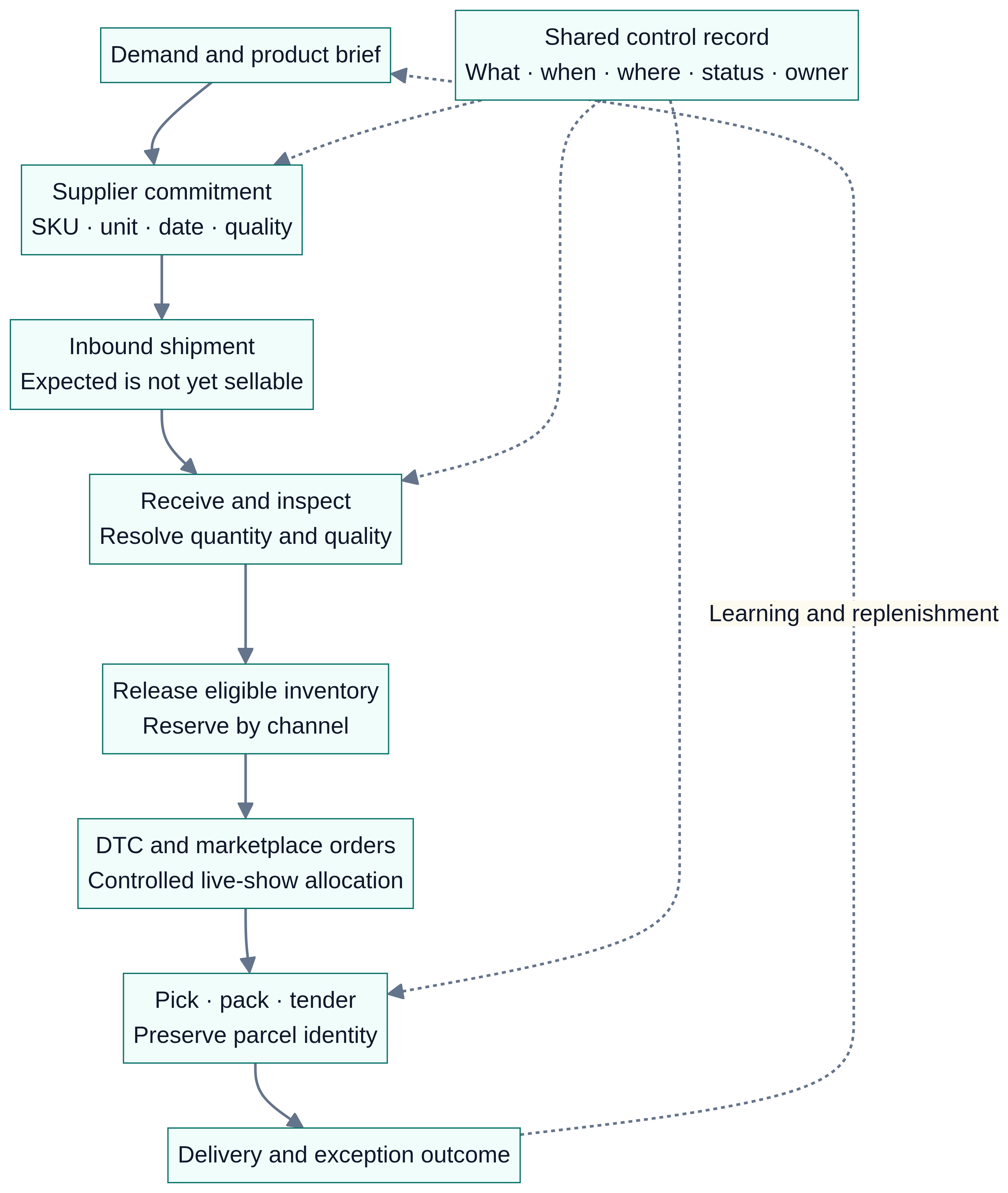
Original editorial framework. The shared control record is a proposed design, not evidence that Dropp operates an EPCIS implementation or a specific control-tower product.
5. Agree What Available Inventory Means
Two systems can show different inventory totals and both be internally correct. One may include committed units, another only sellable units, and a third expected inbound stock. Shopify defines on hand as the sum of available, committed and unavailable inventory, with incoming recorded separately. [2] Never assume a field named stock means the same thing everywhere.
Write a state dictionary and mapping. Explain damaged stock, inspection holds, order commitments, safety buffers and event reservations. Name the authority for each adjustment and retain the reason. If a physical count changes the warehouse record, establish how and when the selling channels receive the revised quantity.
Test stale updates and concurrent demand. A shared database or connector does not by itself prove that every channel transaction is immediate or that overselling is impossible. Set a practical reserve or allocation policy based on the actual workflow. The Shopify fulfillment guide connects platform identity and stock-state questions to a scoping discussion without promising unsupported automation.
6. Reserve Stock for the Channel Promise
A DTC store, a marketplace listing and a live show can have different selling rhythms and operating requirements. Decide which units belong to each channel's available-to-sell pool and when unused reserves return to general availability. Do not reserve the same final units for two separate events because each planner assumes their campaign has priority.
For Whatnot, share the show schedule, planned assortment and expected order grouping before the event. Preserve item identity when baskets contain several purchases. Use current platform instructions for combining and label handling rather than importing a rule from another marketplace. The Whatnot guide and live-commerce fulfillment resource explain this operating context.
For Walmart, seller-fulfilled readiness includes its own settings, packaging and tracking obligations. The Walmart checklist makes that distinction explicit. A common physical stock pool can support a multichannel strategy only if the digital reservations and channel-specific instructions remain coherent.
7. Keep Packaging and Kits in the Supply Plan
Merchandise availability alone does not make an order fulfillable. A subscription kit may need approved components; a fragile basket may need a particular divider; a launch may depend on printed materials. Include those dependencies in the plan rather than discovering them after orders have been released to packing.
Version the bill of materials and pack-out. Define whether a kit is preassembled stock or assembled against orders, how component consumption is recorded and which substitutions are permitted. Treat a substituted component as an approved product decision, not a warehouse improvisation. The kitting guide connects those choices to inventory control.

Editorial warehouse imagery; not a facility audit or evidence of a particular customer's process.
Check the finished parcel dimensions and weight as well as the product itself. The dimensional-weight article explains why a packaging revision needs measurement and protection testing before an assumed shipping saving becomes an operating claim.
8. Connect Physical Events to Usable Information
GS1's EPCIS standard describes sharing information about the what, when, where, why and how of products and assets, including status, location, movement and chain of custody. [3] A small brand does not need to claim a full EPCIS implementation to use the underlying question set when designing its own handoff records.
For each important event, capture the item or order, timestamp, location, quantity, state, source record and accountable role. Distinguish a planned event from a confirmed event. A supplier's expected dispatch date should not be displayed as a physical dispatch merely because both fit a date column. Preserve revisions and original evidence where the workflow requires an audit trail.
Start with the events needed for decisions: supplier confirmation, actual dispatch, received quantity, quality release, reservation, order release, packed parcel, carrier tender and delivery outcome. More data is not automatically more visibility. Information becomes useful when a person knows what action it supports and how to resolve a conflicting record.
9. Manage the Outbound Handoff as Part of the Chain
An order should retain its identity from channel release through warehouse handling and the parcel record. Multi-line baskets and multi-parcel shipments need particular care. Reconcile the units consumed, parcels created and tracking associated with each line. Do not treat label creation as interchangeable with physical carrier possession.
Define the acceptance evidence appropriate to the carrier and channel. Create an owner for missing pickup evidence, unresolved movement or a reported delivery problem. Customer communication should reflect the last verified event rather than a generic status that suggests more certainty than the record supports. The last-mile delivery guide explains that distinction.
This is also where upstream mistakes become visible. Repeated wrong-item shipments may trace to mapping, a packaging error may trace to an obsolete supplier specification, and delayed release may trace to receiving holds. Review the chain before assigning every problem to the final operator who touched the parcel.
10. Measure Decisions and Exceptions, Not Only Volume
Order volume describes activity, not whether the supply chain is under control. Track supplier-date changes, receiving discrepancies, inventory adjustments, reservation conflicts, release delays, missed tender evidence and delivery exceptions. Define the starting event, ending event, denominator and unresolved population for every measure.
| Review area | Useful question | Avoid this shortcut |
|---|---|---|
| Supplier reliability | Which confirmed milestone changed and why? | Combining estimates with actual events |
| Receiving | Which expected units are still unresolved? | Calling every dock arrival available |
| Inventory | Which state or channel caused the variance? | Comparing totals with different definitions |
| Fulfillment | Where did the order wait before tender? | Blaming transit for a warehouse queue |
| Quality | Which product and pack-out version failed? | Mixing all damage reports together |
Use the ecommerce metrics guide to keep reporting definitions stable. These are proposed operating measures, not published Dropp performance figures. Segment by product, channel and event where useful so a change in order mix does not masquerade as an improvement.
11. Run a Weekly Cross-Functional Exception Review
Bring purchasing, operations, marketing, customer service and the relevant fulfillment contact into one short decision review. Focus on unresolved constraints, upcoming campaigns and commitments that no longer match evidence. The meeting should assign actions, not simply read every dashboard aloud. Record the decision owner and the event that will confirm completion.
Review a small sample end to end. Can the team trace a customer parcel back to its approved SKU and receiving record? Can it explain why stock was unavailable during a campaign? Can it identify who approved a changed delivery promise? Missing answers reveal a handoff to improve, not a reason to create an unsupported performance claim.
Keep the horizon practical: immediate order risk, near-term launch readiness and replenishment decisions that need action now. Broader network redesign can follow once the existing chain is visible. The warehouse management guide addresses the local execution layer; this review connects it to supplier and commercial decisions.
12. Choose a 3PL Scope That Matches the Missing Control
Outsourcing is useful when responsibilities are clear. Ask which receiving checks, product attributes, inventory states, channel methods, pack-outs and exception reports the provider can support for your account. Confirm what remains with the brand, supplier, software provider or carrier. Do not assume a marketing phrase such as end-to-end means every decision has been delegated.
Use representative products and orders to test the proposal. Compare ordinary DTC baskets, marketplace requirements and live-show demand separately. Establish a phased launch, acceptance criteria and a rollback or pause condition. The 3PL selection questions and pricing resource help make the scope comparable without inventing a universal cheapest solution.
Frequently Asked Questions
Is supply-chain management the same as fulfillment?
Fulfillment is the order-execution portion. This article's broader operating scope also covers demand assumptions, supplier commitments, inbound evidence and replenishment decisions. A reliable warehouse process needs those upstream inputs to be coherent.
Is incoming stock available to sell?
Not automatically. Shopify explicitly distinguishes incoming from available inventory, and receipt may lead to another state depending on apps or holds. [2] Define the release gate in the actual systems instead of assuming every expected unit is sellable.
Does a brand need an enterprise control-tower platform?
Not necessarily. Begin with consistent identifiers, a state dictionary, named handoffs and a usable exception record. More advanced systems can help when the operating requirements justify them, but software does not replace agreement on what each event means.
How does live commerce change planning?
It concentrates demand and makes reservations, materials, order grouping and collection capacity more time-sensitive. Plan an event-specific allocation and release rule while keeping the platform's current instructions distinct from those of DTC stores and marketplaces.
Build a Manufacturer-to-Customer Brief
Bring your product crosswalk, supplier milestones, receiving exceptions, stock-state definitions, channel calendar and sample parcels to a fulfillment planning conversation. Use the FAQ and glossary to align terms. Start with the weakest handoff, define its owner and evidence, then expand a tested operating model rather than promising visibility that the records cannot yet support.
References
- GS1 — Global Trade Item Number.
- Shopify — Understanding Inventory States.
- GS1 — EPCIS and Core Business Vocabulary.
Source review: October 15, 2026. The framework is editorial guidance, not a certification statement, integration specification, customer case study or guaranteed result.