

A Marketplace Listing Is Not a Fulfillment Operating Plan
Opening another sales channel creates more than another order feed. A Walmart Marketplace customer sees an item, a delivery promise and a seller responsible for the outcome. Behind that experience sit product mapping, available stock, warehouse schedules, packaging rules, carrier collection and customer communication. If those controls disagree, additional sales can expose an existing operating gap rather than solve a growth problem.
This guide is a seller-fulfilled readiness checklist, not an application for Walmart Fulfillment Services, a certification claim or a guarantee that a particular 3PL will meet every marketplace standard. Walmart policies cited here were reviewed on October 15, 2026. Current Seller Center instructions, account settings and applicable policy updates control. The proposed worksheets describe how a brand can organize its review; they are not measured Dropp customer results.
Use the Walmart fulfillment guide for the service-scoping conversation and the ecommerce fulfillment resource for the underlying warehouse process. The aim is to make a supported promise, preserve evidence and detect exceptions while there is still time to act.
1. Decide Which Fulfillment Model You Are Actually Using
Seller fulfillment and Walmart Fulfillment Services are different operating models. WFS is Walmart's own program: sellers send eligible inventory to assigned Walmart fulfillment centers, and Walmart describes picking, packing, shipping, customer support and returns for those orders. Its eligibility, fees and program instructions belong to Walmart. They are not evidence that an independent 3PL offers the same program or benefits. [1]
For seller-fulfilled orders, define which warehouse handles each item, who administers Seller Center, how orders reach the warehouse and who owns the customer-service obligation. An external provider can perform agreed tasks without taking over the seller's marketplace accountability. Avoid calling a proposed connection a native integration until its actual method and supported events have been confirmed.
| Model boundary | Readiness question |
|---|---|
| WFS | Are these items enrolled, eligible and available in Walmart's program? |
| Seller-fulfilled | Which named operation will prepare and tender each order? |
| Mixed catalog | Can the team distinguish the fulfillment model by item and order? |
| Shared DTC stock | Which units are reserved, unavailable or committed elsewhere? |
2. Build a Product and Unit-of-Measure Crosswalk
Create one approved mapping between the marketplace item, seller SKU, warehouse SKU and physical sellable unit. Identify variations, multipacks, kits and replacement packaging. A case of twelve and a single unit must not share an ambiguous instruction. Treat unknown mappings as an exception requiring a decision, not as permission to ship the closest-looking product.
Ask the warehouse to validate representative barcode scans and actual contents. Preserve the approved product name, unit, dimensions, weight and pack-out version alongside the mapping. If the brand changes a bundle, do not assume the earlier component list still describes it. Review whether the change affects inventory consumption and the shipping parcel as well as the storefront description.
The SKU management guide explains the internal identity problem. For Walmart readiness, add the marketplace identity and order-line reference so a later shipment inquiry can be traced back to the exact product definition used at release.
3. Publish Only Inventory That the Operation Can Release
A supplier promise, an inbound shipment and a counted warehouse unit are not the same inventory state. Define when receiving is complete, which quality holds block sale, how committed quantities are deducted and which channel reserves apply. A marketplace quantity should represent a deliberate selling decision rather than the largest number visible in a connected system.
Shopify's own inventory model illustrates why terminology matters: on hand includes available, committed and unavailable units; incoming inventory is separate from availability until received and appropriately released. [4] This is a useful comparison for a multichannel brand, not a claim that Walmart or every warehouse uses identical field names.
Document the source of truth, update method, expected update frequency and stale-data escalation. Test what happens when a feed fails or a manual adjustment occurs. If the connection is not proven to prevent concurrent sales, use a conservative allocation rule rather than promising zero oversells. Keep reservations for a Whatnot show visible to the marketplace planning team.
4. Align Operating Schedules, Lag Time and Delivery Promises
Walmart's Shipping & Fulfillment Policy requires a configured operating schedule for each active fulfillment center, support for shipments until at least 11:00 a.m. local time at least five days per week, and an appropriate lag time, carrier and service level to meet the Expected Delivery Date. The policy also requires shipping within two operational days unless Walmart has approved an exemption. [2]
Those requirements are not a universal two-day delivery promise. Preparation time, operational days, order settings and transit are different inputs. Confirm the actual origin, pickup calendar, holidays and product handling. Where the policy distinguishes zero-day lag and positive lag, follow the current account logic rather than applying one remembered cutoff rule to every order.
Have the seller and warehouse approve a shared schedule record. Include the next review date and an owner for changes. A warehouse closure that never reaches Seller Center can leave the customer promise inconsistent with the physical operation. The two-day shipping article helps separate transit speed from the full order journey.
5. Treat Order Release as a Decision with Evidence
Before a warehouse releases an order, it should be able to identify the order lines, eligible stock, ship-from location, expected shipping milestone and approved service mapping. Establish how holds, cancellation requests and address exceptions are handled. A successful file transfer alone does not establish that the order is ready for physical fulfillment.
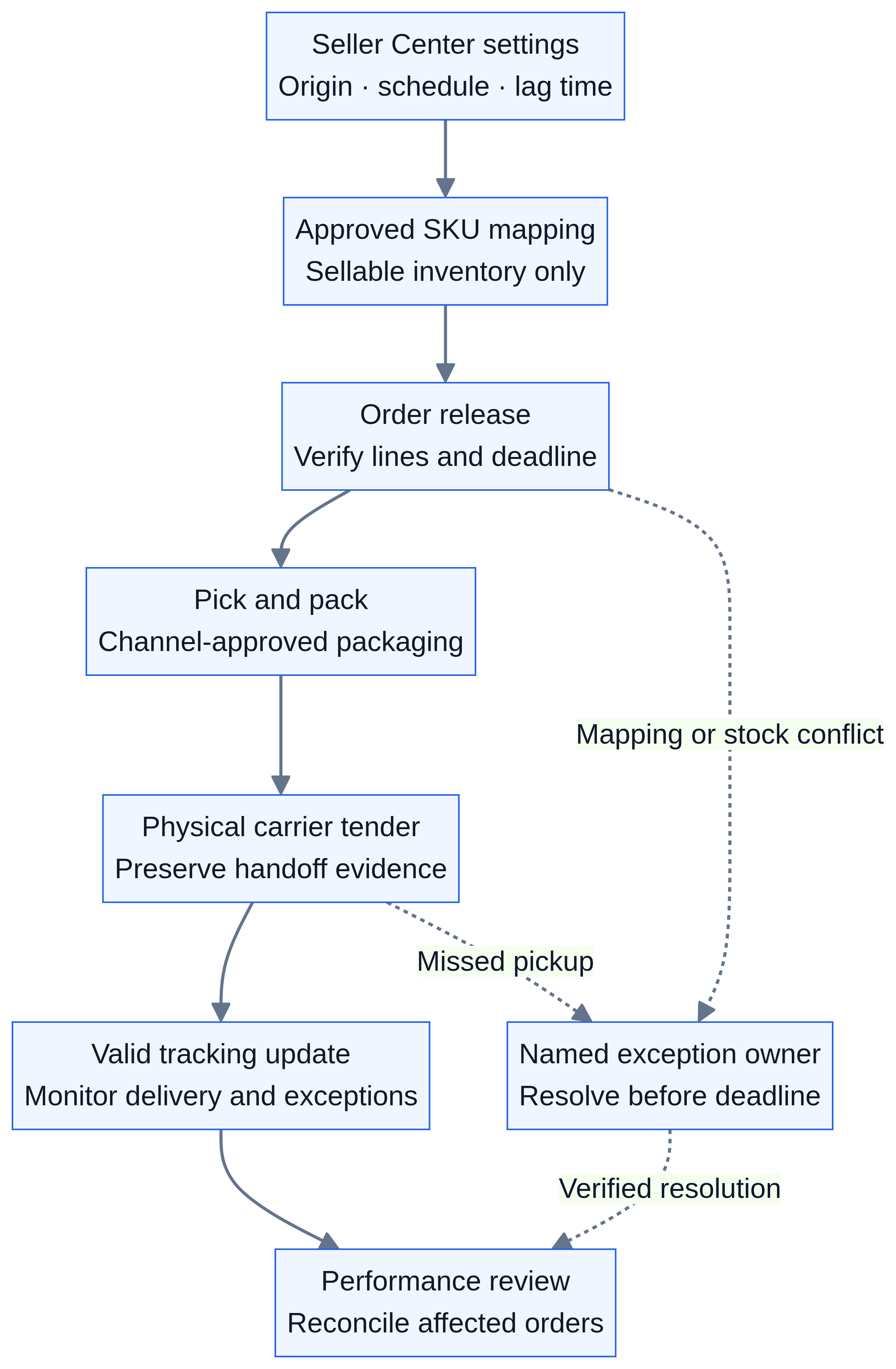
Original editorial process map. Each control requires account-specific agreement; this is not evidence of a deployed connection or guaranteed marketplace outcome.
Test duplicate imports, retries, split lines and canceled orders with the actual proposed workflow. Decide who can release a held order and how that decision is recorded. Preserve marketplace identity through every downstream reference so a warehouse completion event cannot accidentally close the wrong order. An integration review is incomplete if it tests only the easiest single-item purchase.
6. Approve Packaging Specifically for Walmart Orders
A DTC presentation playbook is not automatically appropriate for a marketplace parcel. Walmart's policy prohibits competitor boxes and packaging, restricts other-entity identifiers unless an exception is granted, and prohibits seller or third-party promotional and marketing materials such as coupons, surveys and review requests. When other-retailer multichannel fulfillment is used, neutral packaging and unbranded delivery-vehicle conditions also apply. [2]
Create a channel-specific pack-out that protects the product while respecting those rules. Inspect the packing slip, exterior box, cushioning, invoice and inserts together. A neutral outer carton does not solve a prohibited promotional leaflet hidden inside it. If an exception is relevant, retain the approval rather than relying on a verbal assumption.

Editorial imagery only. Product protection and marketplace packaging review must be validated independently.
Use the dimensional-weight guide to evaluate the finished parcel. Cost and presentation matter, but neither justifies copying a DTC insert instruction into a channel where it is prohibited.
7. Separate Label Creation from Physical Carrier Tender
Walmart requires accurate, valid tracking information to be communicated only after a package has been tendered to the carrier. It also prohibits marking an order shipped without physically shipping it. [2] A label can be an important preparation artifact without satisfying that physical boundary.
Reconcile ready parcels, the pickup record, handoff evidence and accepted tracking updates. Name the role that investigates a missed collection or a parcel with no qualifying movement. Check carrier identity and service mappings as well as the tracking number; an apparently plausible number attached to the wrong carrier can still create an unusable customer record.
Do not backdate a shipment or generate a replacement number merely to make the dashboard look complete. Preserve the actual sequence and resolve the underlying gap. The last-mile delivery guide connects warehouse evidence to later tracking events while making clear that carrier acceptance and final local delivery are separate stages.
8. Review Performance with the Correct Definitions
The Seller Performance Standards page reviewed for this article specifies rolling 30- or 60-day evaluation and warns that standards can change, including existing and upcoming requirements. Selected listed standards are shown below; consult the full dashboard for all applicable metrics and account-specific treatment. These figures are Walmart seller standards, not Dropp performance statistics. [3]
| Selected listed standard | Threshold in the reviewed policy | Operational evidence to examine |
|---|---|---|
| Cancellation Rate | 2% or below | Stock conflicts, pricing or expired shipping windows |
| On-Time Delivery Rate | 90% or above | Promise, origin, service, handoff and delivery events |
| Valid Tracking Rate | 99% or above | Accurate carrier, number and qualifying tracking evidence |
| Seller Response Rate | 95% or above within 48 hours | Inquiry receipt, owner and actual response |
| Late Shipment Rate | 5% or below | Expected Ship Date, tender and recorded shipping event |
Do not average incompatible windows or silently remove unresolved orders. Investigate the affected order cohort and the drivers assigned in Seller Center. The policy distinguishes seller-accountable and not-accountable factors; preserve evidence and use the appropriate review route instead of assuming every exception is automatically excluded.
9. Give Exceptions a Named Owner and a Deadline
Build a queue that records the affected order, risk, last verified event, next action, responsible role and next review time. Stock mismatches, unclear addresses, damaged units, missed pickup and delivery exceptions require different actions. A general inbox is not enough if everyone expects another team to respond.
The brand should decide who communicates with customers through permitted channels, who can approve a resolution and who checks current marketplace instructions. Warehouse staff should preserve pick, pack and handoff evidence within the agreed scope. The carrier liaison should investigate transport evidence. These responsibilities are a proposed division of work, not a claim that any provider controls all outcomes.
Set escalation early enough to be useful. A report delivered after every affected shipping window closes may be accurate but operationally late. Use the 3PL SLA guide to define start events, measurement windows, exclusions and escalation rather than negotiating only an attractive headline processing speed.
10. Protect DTC and Live-Commerce Commitments
Adding Walmart should not make existing Shopify customers or live-show buyers compete unknowingly for the same final unit. Build a channel allocation plan before promotions. Identify merchandise reserved for an event, the release condition for unsold units, packaging requirements by channel and the available collection capacity.
The Shopify guide, Whatnot guide and TikTok Shop guide address different channel contexts. Do not transplant shipping deadlines, packaging permissions or order-combining rules from one to another. A shared physical warehouse can still require distinct digital and operating rules.
Agree a practical demand range with the provider. If the incoming queue exceeds agreed recoverable capacity, change the selling or release plan and escalate transparently. Neither a marketplace listing nor an API connection proves unlimited surge capacity. Growth is better supported by a visible constraint than by a promise to process every possible spike identically.
11. Run a Controlled Launch, Not Just a Connection Test
Build a launch worksheet covering ordinary orders and failure paths. Include mapping conflicts, partial availability, duplicated messages, order changes, canceled orders, multi-parcel shipments, missed pickup and delayed updates. Define the expected outcome for each case before running it. Where a case cannot safely be exercised in a live account, use an approved test method and record the remaining limitation.
Keep the initial catalog and demand scope narrow enough to investigate. Reconcile orders, physical units, parcels, tracking and inventory changes at the end of the pilot. Expand only when the team understands the failures and can explain how they are handled. A clean sample is evidence about that sample, not a permanent guarantee for all products and destinations.
Frequently Asked Questions
Does hiring a 3PL make an order WFS?
No. WFS is Walmart's separate program with its own enrollment and operating rules. Independent seller-fulfilled support does not create WFS status or prove a Walmart partnership. [1]
Must every Walmart parcel arrive in two days?
Do not confuse shipping preparation with delivery. The reviewed policy describes shipping within two operational days unless an exemption is approved, while the Expected Delivery Date depends on relevant settings and transit. The current account instructions govern. [2]
Can a seller include a standard promotional insert?
The cited policy prohibits seller and third-party promotional or marketing materials. Review the complete current packaging policy and any documented exception before approving the pack-out. [2]
Does a tracking number prove dispatch?
Not by itself. Walmart's policy requires physical shipment and says to communicate tracking after carrier tender. Match the record to actual handoff evidence. [2]
Prepare a Seller-Fulfilled Scope
Bring representative SKUs, fulfillment models, Seller Center settings, recent order examples, destinations, finished parcel measurements and exception patterns to a fulfillment scoping discussion. Compare the pricing inputs, clarify terminology in the glossary, and connect replenishment planning to manufacturer-to-customer supply-chain management. Agree the workflow before claiming the outcome.
References
- Walmart — WFS Overview.
- Walmart — Shipping & Fulfillment Policy.
- Walmart — Seller Performance Standards.
- Shopify — Understanding Inventory States.
Source review: October 15, 2026. Editorial operating guidance; no certification, fixed implementation time, badge, ranking or performance guarantee.